

Integrated yoga, meditation, and therapy advancing justice, resilience, and community healing in Kansas City.
The HEALwell team designs specially crafted curriculums for at-risk, underserved communities in Kansas City. We have taken a bold step forward in wellness by combining both body and mind into an integrated system for recovery and resilience.
Our inaugural program is HEALING JUSTICE in collaboration with the KCMO Wellness Court, and our newest program is HEALwell with Aim4Peace. Read more about those programs below.
If you are interested in bringing our unique system of Yoga, Meditation, and Therapy to your community, reach out to us at healwell@aim-well.org. We tailor each program to your specific needs and desired outcomes.
Welcome to the next generation of wellness.
Healing Justice
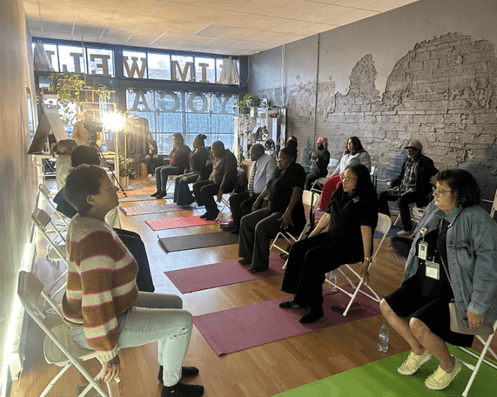
Healing Justice is a collaborative, person-first support program designed for participants in Kansas City’s Wellness Court. Wellness Court serves individuals convicted of non-violent offenses who choose to engage in a structured, year-long alternative to traditional sentencing. Through coordinated oversight, case management, and access to community resources, participants work toward stability and accountability; upon successful completion, their record is wiped clean. Healing Justice complements this legal and social framework by addressing the internal dimensions of change—stress regulation, trauma processing, self-awareness, and relational capacity.
Many Wellness Court participants carry layered experiences of trauma, addiction, chronic stress, and systemic marginalization. Healing Justice recognizes that sustainable behavior change does not come from compliance alone; it emerges from nervous system regulation, embodied self-understanding, and restored agency. Our curriculum weaves trauma-informed yoga, guided meditation, and clinically grounded Cognitive Behavioral Therapy into a cohesive arc that supports participants during an 8 week closed cohort.
Yoga modules focus on rebuilding trust in the body. Through breathwork, strength-building, and accessible movement, participants learn to recognize physiological cues of activation and shutdown. They practice down-regulation skills that can interrupt impulsive behaviors and reduce stress reactivity. Meditation sessions cultivate attention, emotional literacy, and non-judgmental awareness—skills essential for interrupting habitual patterns and developing agency. Cognitive Behavioral Therapy, facilitated with clinical rigor, creates a structured space for reflection, accountability, and interpersonal growth.
The only municipal court and Y-CBT partnership and research initiative in the nation.
HEALwell with Aim4Peace
HEALwell was built as a resilience-building initiative developed in partnership with Aim4Peace, Kansas City’s violence reduction and prevention program. Aim4Peace case managers operate on the front lines of community crisis, responding directly to incidents of violence and working closely with victims, families, and perpetrators. As peer counselors, they serve as trusted sounding boards, connectors to resources, and stabilizing presences in moments of acute distress. The emotional and physiological toll of this work is significant. HEALwell exists to support these case managers in sustaining their capacity to serve.
Unlike Healing Justice, which focuses on court participants, HEALwell centers the caregivers. The program recognizes that effective violence interruption and community stabilization require regulated, supported practitioners. Chronic exposure to trauma, grief, and high-stakes conflict can lead to burnout, secondary traumatic stress, and compassion fatigue. HEALwell addresses these risks through an integrated curriculum of trauma-informed yoga, meditation, and therapeutic group processing tailored specifically to the lived realities of Aim4Peace staff.
Somatic modules help case managers understand how trauma exposure lives in the body. Through guided movement, breathwork, and grounding exercises, participants learn to identify stress signatures—tightness, hypervigilance, numbness—and practice techniques for resetting their nervous systems between calls and after critical incidents. These skills are practical and portable, designed for immediate use in the field. Meditation sessions strengthen attention, deepen self-awareness, and cultivate reflective pause, allowing case managers to remain present without becoming overwhelmed.
Therapeutic group spaces provide structured opportunities to process experiences collectively. Facilitated by a clinician skilled in group dynamics, sessions emphasize containment, confidentiality, and mutual respect. Case managers explore themes such as boundary-setting, moral injury, grief accumulation, and the complexity of holding empathy for all parties involved in violence. By naming and metabolizing these experiences together, the group reduces isolation and reinforces shared purpose.
HEALwell is grounded in the belief that resilience is not an individual trait but a collective practice. Peer counselors already embody leadership within their communities; this program strengthens their internal scaffolding so that their service remains sustainable. Participants develop language for self-advocacy, clearer boundaries around work-life integration, and tools for decompression and restoration.
the team

Left-to-Right:
Nettie Zan
Researcher/ Meditation Instructor
Debonie Lewis
Principal Investigator/ Yoga Instructor
Dr. Casey Bodenhausen
Researcher/ Couseling Psychologist
Healing Justice and HEALwell are led by a multidisciplinary team rooted in Kansas City’s communities. Debonie Lewis, founder of AIMwell Yoga in the historic Troost corridor, serves as lead yoga instructor. Her teaching integrates accessible movement and trauma-informed sequencing designed to meet participants where they are. Grounded in neighborhood relationships and years of community engagement, Debonie brings both technical skill and cultural responsiveness to each session.
Nettie Zan, lead meditation guide, is a local artist and community builder whose work bridges contemplative practice and creative expression. Their facilitation emphasizes presence, imagination, and collective reflection. Nettie crafts meditation experiences that are approachable and resonant, helping participants cultivate attention, self-compassion, and emotional clarity.
Dr. Casey Bodenhausen, couseling psychologist, anchors the therapeutic components of both programs. With specialized expertise in group processing, Dr. Casey ensures that all offerings are clinically sound and ethically grounded. Her facilitation balances structure and flexibility, fostering spaces where growth and healing are supported. Dr. Casey is passionate about the wellness of our Kansas City community and about expanding access to integrative, evidence-based care.
Together, the team integrates movement, mindfulness, and therapy into cohesive programs tailored to justice-involved individuals and frontline violence prevention workers. Their combined experience in community practice, clinical care, and embodied arts positions Healing Justice and HEALwell as innovative models for holistic, locally rooted transformation.
Why “Healing Justice” Matters

Sets Kansas City Apart - As a leader in comprehensive wellness-based diversion program, this model places Kansas City at the forefront of justice innovation.
Innovative programming that is not being implemented anywhere else on a municipal level. The “Prison Yoga Project” is the closest comparison targeting state prisons.
Led by specialized Kansas City resources, uniquely trained for this type of instruction
Addresses the root causes of repeat offenses: unmanaged stress, trauma, and emotional dysregulation through somatic experiences and changes in ways of thinking
Evidence Based & Cost Effective:
CBT-based interventions show an average 25% reduction in reoffense rates (Lipsey et al., 2007).
CBT programs generate over $7 in public safety benefit for every $1 spent (WSIPP, 2018).
Aligns with public health models for rehabilitation over punishment
